
If you have ever travelled to India, you’ll agree that the drive from Delhi to Punjab is a tough one. After flying halfway across the world on long flights (14 hours in my case this time), we make our way to our villages, tired, weary and eager to get home. Depending on where in Punjab you are headed, the drive is at least seven hours or more.
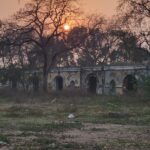
For as long as I can remember, I recall looking out the window of the car waiting to see a sign which would signal that we are close to home. When my eyes would come across a massive red structure in the middle of wheat fields next to a stunning gurdwara, my heart would skip a beat because I knew home was not too far away. As a child, I always thought this gigantic building was an old castle, and each time I saw it, my mind would fill with thoughts of kings, queens and magnificent banquets and feasts. As I grew older, I learned it was from the Mughal era and based on my limited knowledge of the era and lack of initiative to look into it further, I assumed it was a fort.
I’ve been to Punjab three times prior to this trip as an adult, but I’ve never made the time to visit this landmark. As I’ve shared before, this trip to Punjab is both different and significant. Life is short and unpredictable, therefore if one has questions on their mind or something they’re curious about, they should endeavour to find the answers and satisfy said curiosity. With this in mind, I decided I would make the time to visit the fort I’ve admired from afar for so many years.
As we left home, I felt feelings of anxiety and dread in the pit of my stomach. My experience with the Lodhi Fort a few days earlier was fresh on my mind, so I didn’t know what to expect. I had heard that this place was in bad shape as well, so I prepared myself for the worst as we approached it.
To my surprise, we pulled up to a bustle of activity in and around the building. In speaking with the security guard posted outside the towering medieval gate, we learned that the government had commissioned a full restoration of the complex. After I studied the sign posted outside the entrance, I learned that this structure that had made my heart skip a beat each time I saw it wasn’t a fort, but rather a rest stop – a “serai” in Punjabi.
Built in the 16th century and named after the Mughal general who oversaw its completion, Serai Lashkari Khan served as a place for weary armies to rest as they travelled across Northern India. Built in the 16th century and strategically situated on the main trading route of the Grand Trunk Road (GT Road), Serai Lashkari Khan has stood for centuries, and now serves as a reminder of an era long gone.
The guard allowed us to walk around inside, where an eager labourer became our impromptu tour guide, pointing out the three wells that quenched the thirst of the exhausted travellers that stopped to rest in the serai. He also showed us the now abandoned mosque where travellers could offer a prayer of thanks for making it that far, and ask for blessings as they continued forward to their final destination. We stopped inside the various rooms and were told how the labourers were given temporary residence in the quarters – living and sleeping in the same place that once gave shelter to fierce generals and soldiers.
In walking around the serai and thinking about its significance, I pictured armies marching down an ancient GT Road, the same road I take to get home from Delhi, and imagined them breathing a sigh of relief when the serai was in sight, much like I did each time I saw it en route to our village.
As I explored and let the serai share its story with me, my thoughts turned to its creator. Lashkari Khan is long gone, but his serai still stands. Although it doesn’t house armies anymore, it still gives hope to weary travellers like me when it comes into sight.
Lashkari Khan had no idea the mosque he prayed in would one day be abandoned.
He had no idea the wells that provided the refreshing water that soothed his parched throat after a long journey would one day be dry.
He had no idea his creation would one day be in a terrible state and on the brink of oblivion, only to be saved and restored to its former glory.
He did, however, know that his serai would give those tired from their travels a feeling of relief and hope when their eyes caught sight of it. I pray wherever his soul is now, it knows that what he built continues to do that which it was meant to do, albeit in a different way – hundreds of years after he breathed his last.