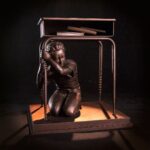

I recently had the privilege of watching a fantastic play called “Himmat” at The Cultch, and was blown away by how phenomenal the production was.
It centers around an ailing father recounting his life story to his young daughter, and will surely strike a chord with anyone who grew up as the child of Punjabi immigrants. It explores topics such as addiction and its impact on not only the addict, but also those in their lives. It also highlights the struggles our parents faced as newcomers to this country, including the pain they felt leaving the land they loved to start a new life.
I found myself nodding in agreement and nostalgia throughout the play, but a scene that really struck home for me was a racist encounter a young Punjabi couple experiences that leaves them both very shaken.
For several days now, I’ve been reflecting on this particular scene and replaying it in my head over and over again.
When I was really young, we lived in Delta, BC. Like the couple in the play, our family also experienced racism in the form of verbal abuse, in addition to regular vandalism. One of my most vivid memories from that period is having a rock come through our front window, narrowly missing my head one night.
A few years ago, my nephew found a news article from The Vancouver Sun, written six months before I was born. In it, the reporter writes about how a Punjabi immigrant family’s home was fire bombed in Delta. The Punjabi community in the Lower Mainland was small at the time, so an act like this brought everyone together to offer support, including my family. To my surprise, the reporter actually spoke to my dad, and writes that he shared that our family had also been victims of racist attacks, with the windows of our house being broken and vehicles damaged.
There are a few gems from him in this article that illustrate what Punjabi immigrants went through when they first got here back then, but since my nephew is the one who found it, I’ll let him be the one that will share it when he’s ready. One of the things I will share is a quote from my dad that really resonated with me:
“Hara said he is not frightened.”
I think this quote sums up the collective mindset of Punjabi immigrants in the Lower Mainland at the time.
Despite being constantly reminded that they weren’t welcome, they didn’t bend. Instead, they worked hard, stood their ground, and overcame. They displayed an immense of amount of resilience, refusing to accept racism as a fact of life.
Since I’ve watched the play, I’ve been thinking about how hard it must have been for people like my parents to leave Punjab and travel halfway across the world to a place where their arrival was met with such hatred and intolerance. It makes me look at my own life and appreciate what those who came before me had to go through.
After the show, we went to the Coal Harbour Cactus Club in Vancouver for dinner. From where we were seated, I had a perfect view of the harbour, including the Chevron gas station in the middle of it. I’ve heard somewhere that the gas station is roughly in the same spot that the Komagata Maru stood for two months before being turned away from Canada in 1914.
Of the 376 passengers on board, one was a man named Deva Singh, who hailed from the same village in Punjab from which my family comes from. As I looked out at the dark waters of the harbour, I pictured the massive ship sitting patiently where the gas station now stands. I imagined those aboard the Komagata Maru waiting to hear the decision on their fate with eagerness and uncertainty. I pictured Deva Singh standing on its deck, perhaps looking out at the very spot the restaurant I was sitting in is now. I could feel his hope and excitement at the prospect of a new life. I could also feel his disappointment when he heard the news that the passengers of the Komagata Maru would not be allowed to come ashore, and as a result, be forced to return back to India. I pictured him looking back at Vancouver one last time before it disappeared from view as the ship made its way back to open water, knowing he would never see this land again.
Since watching the play, I wish I could go back in time and tell Baba Deva Singh that one day, things would change. I wish I could tell him that 67 years after he was turned away from this beautiful country, a man from his village would stand on the ground he and his fellow passengers had tried so valiantly to set foot upon and defiantly proclaim to those who where trying to intimidate him and his community that he wasn’t frightened. I wish I could tell him that 108 years after he last saw Coal Harbour, a man from his village would attend a play that made him reflect on all those who dared to stand up to intolerance and racism, and then have dinner looking out at the very spot where he had stood.
Above all, I wish I could tell him how much we appreciate the himmat, which translates to courage – he and his fellow passengers showed. They inspired thousands of immigrants like my parents to never give up hope and never let their himmat waver.
In closing, I’d like to thank those who put this beautiful production together. It was a great reminder of the sacrifices, trials and tribulations those who came before us made and went through so that we can live the lives we do – a fact we are all guilty of forgetting sometimes.
To put it simply, we are forever grateful.
“It is in the roots, not the branches, that a tree’s greatest strength lies.” – Matshona Dhliwa